Enrique Marty Spain, b. 1969
Cycle III: Vegetal Proliferation
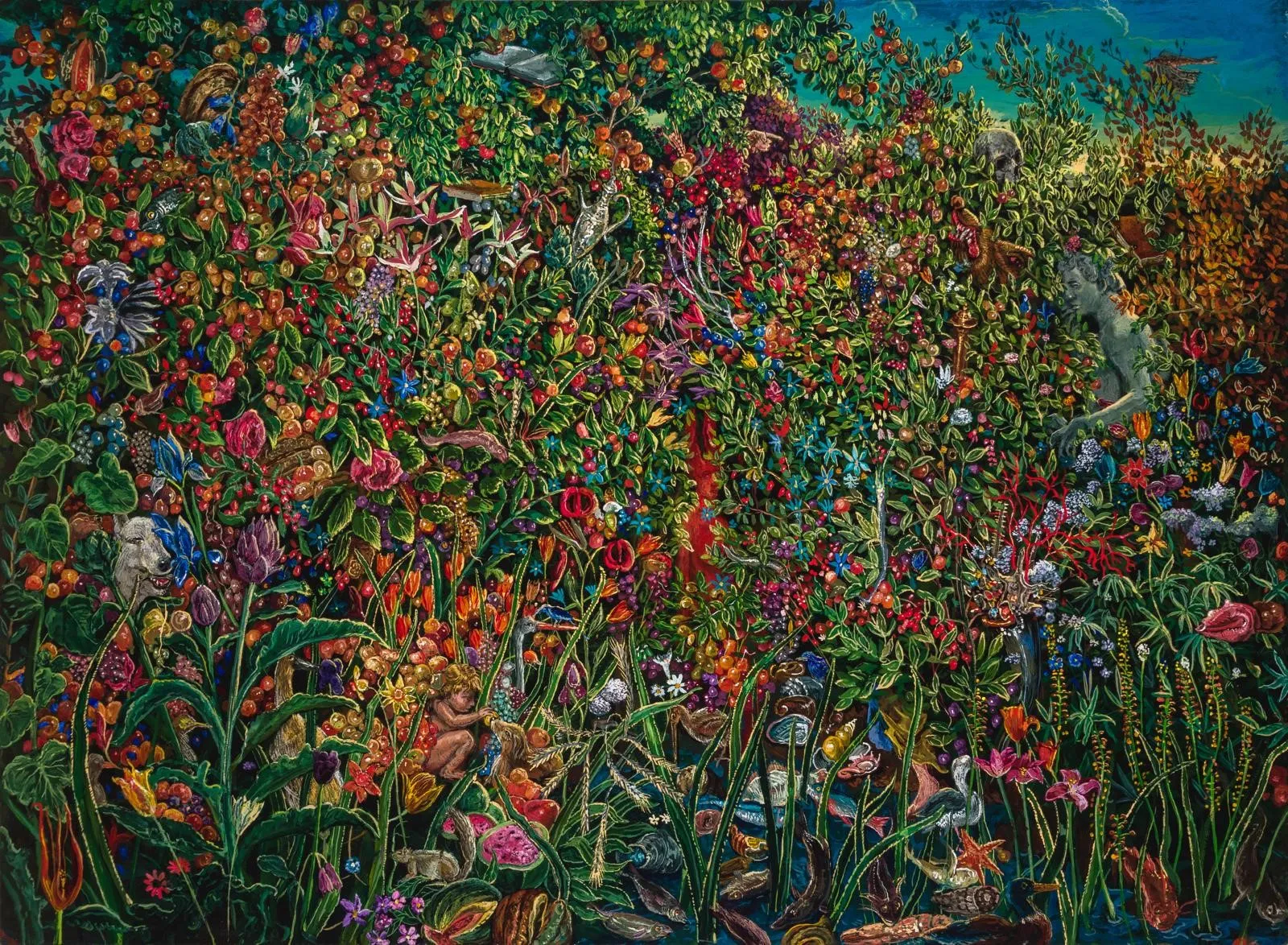
In the third cycle, the landscape closes in on itself, becoming dense and saturated. Vegetation, fruits, animals and fragments of bodies accumulate into a continuous field of organic matter.
These works evoke both the Baroque garden--where excess and ornament dominate--and the still-life tradition of vanitas, where beauty and decay coexist. Yet here the distinction between life and death collapses. Matter appears in a constant stat of transition: growing, decaying and regenerating simultaneously.
Spatial hierarchy dissolves. Foreground and background merge into a single surface of proliferation. The viewer's gaze must move through layers of density, encountering multiple micro-scenes embedded within the whole.
Human presence, when it appears, is absorbed into the vegetal environment. The boundary between human and nature becomes unstable. The storm is no longer atmospheric or geological--it is immannet in matter itself, in the endless transformation of organic life.